(**1/2)
Sticks and stones won’t break her bones, but words will really hurt her.
It’s easy to sympathize with Fisherwoman (Olivia Colman), a hardworking, well-known member of her village who’s constantly ridiculed. Folks can smell her coming from a mile away as she sells her catch of the day. Some take great joy in degrading her and her occupation, especially the Tailor’s Wife (Elizabeth Debicki), who leads the other mean girls in making Fisherwoman’s life miserable. All the lonely woman wants is what they seem to have: love, affection and a man.
Ursula Wills’ short story “The Wicker Husband” thoughtfully explores a protagonist so desperate for companionship that she wants a spouse custom-built. The me-against-the-world setup, coupled with the ingenuity of breaking the mold, makes a compelling premise. Set in the 17th century, the story unfolds in a fictional rural village where folks don’t have names and are called by their professions. The setting is ripe for a fable, in the tradition of the Grimm fairy tales, with lessons to impart, villains who bully the innocent and a touch of magic and whimsy.
Writers-directors Alex Huston Fischer and Eleanor Wilson unevenly bring this medieval story to life. Some scenes are fantastical. Others are too stagey and talky, especially the village scenes, which look more like a backlot than a lived-in community. Cinematographer Lol Crawley (The Brutalist) fares better with intimate firelit interiors and captivating pastoral landscapes. Production designer Renátó Cseh likewise makes the homes and barns more convincing than the town itself.
Costume designers Tóth András Dániel and Attila Godena-Juhász dress Fisherwoman simply and appropriately, while the Basketmaker’s wardrobe features an eye-catching mix of fabrics and colors. Many villagers’ clothes, however, look too new and clean for the rustic setting. Editor Sofi Marshall effectively weaves together gossipy village chatter, erotic scenes and agrarian life. Anna Meredith’s musical score, with its dissonant strings, embellishes the story’s sorrow, joy and menace. All in all, it feels like someone is turning the pages of a storybook—but not one meant for a kindergarten class.
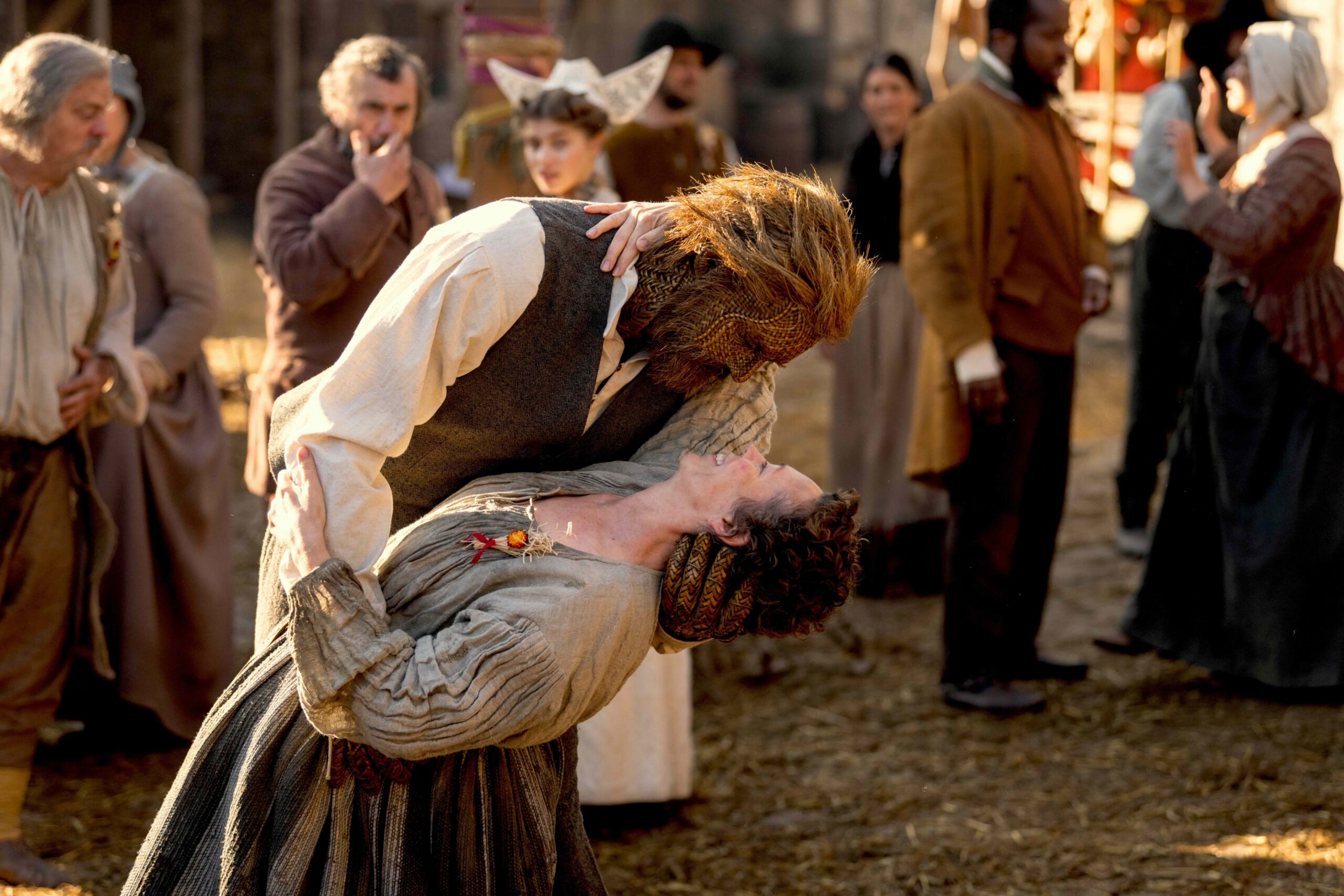
Desperate but determined, Fisherwoman approaches the local Basketmaker (Peter Dinklage) with an unusual request: “I want you to make me a husband.” He obliges, and it turns out that her handful of coins buys her a whole lot of man. The Wicker Husband (Alexander Skarsgård) is tall, dark and handsome. A hunk of sticks. They retreat to her little farmhouse. And as new lovers do, after feeling each other out emotionally, physically and sexually, they make wild, passionate love. In fact, the villagers can hear Fisherwoman’s moans and groans throughout the valley. Their sexcapades are so vigorous that they break her bed! Even after the townspeople learn to accept the new, unusual couple, jealousy persists. And the Tailor’s Wife? She, like a witch, venomously plots their downfall.
The script gets some aspects right, sustaining interest while raising questions about tolerance, acceptance and conventional notions about love and marriage. Fisherwoman’s rejection of the town’s tradition of a bride wearing a matrimonial collar shows her defiant nature. Her romance also challenges the expectation that people should only date within their own race, religion or social class. These are noble themes.
The screenplay’s two main structural weaknesses become more apparent around the 45-minute mark, after the novelty of the premise wears off. First, the villagers’ cruelty provides the story’s most compelling source of dramatic tension. Yet Fisherwoman’s insecurity becomes a primary antagonist in its own right, shifting attention away from that stronger external conflict without developing her inner struggles sufficiently. Second, protagonists have to slay their own dragons. Relying on someone else to settle the score denies Fisherwoman the opportunity to claim her victory—and deprives the audience of the satisfaction of watching her do so.
The directors’ interpretation of this romantic comedy-drama is competent, though at times a looser, more improvisational approach—with the comic timing of an SNL skit and less dialogue—might have made the characters feel more natural. For example, Dinklage’s long-winded monologues seem out of place, better suited to a West End play. The Basketmaker is far more interesting when he’s weaving wicker figures and toying with the mean villagers than when delivering extended speeches.
Fisherwoman is a complex character filled with anxiety, self-doubt, hope, lust and frustration. Colman gets to the heart of her character, making her humor, outrage, vulnerability and desire feel authentic. Skarsgård turns the man-made man into the town stud, radiating love, sex appeal and sensitivity. Beneath his wooden façade, he reveals a gentle, intelligent nature, far removed from the lumbering brute audiences might associate with Frankenstein’s monster. He declares, “You are the reason I live and breathe,” conveying that tenderness with ease, even while wearing an eye-catching wicker bodysuit and mask created by Joe Dunckley and Wētā Workshop (Avatar). Debicki makes the disgruntled wife suitably malicious, while Dinklage brings wisdom to the Basketmaker. The supporting cast (Richard E. Grant, Nabhaan Rizwan, Ella Bruccoleri and Kiell Smith-Bynoe) blends into the film’s storybook atmosphere, like members of a traveling theater troupe.
Yes, Wicker is a feminist story, and Fisherwoman challenges the social order that expects her to conform. But a stronger feminist allegory would give her a more active role in outsmarting her tormentors. She needn’t break bones with sticks and stones; she needs to shape her own destiny. That’s a triumph that audiences could cheer.
Trailer: https://www.youtube.com/watch?v=job8V254NAE
Visit Film Critic Dwight Brown at DwightBrownInk.com.