(***1/2)
It’s a history lesson wrapped in a period drama. An intimate look at British colonialism and land appropriation in Palestine, 1936. The beginnings of a conflict that continues 90 years later.
British-controlled Palestine, later Israel in 1948, had a rich, diverse history before colonization. For 400 years, until 1917, it was a multicultural part of the Ottoman Empire. Arab Muslims and Arab Christians were the predominant population, Jewish communities the minority. British forces captured Jerusalem in 1917, and the region in 1918. The League of Nations assigned Britain the job of administration and managing the territory via an official “Mandate” in 1920. Historians cite strategic interests, including maintaining influence over routes near the Suez Canal, as a key motivation. In addition, the “Balfour Declaration” of 1917 supported establishing “a national home for Jewish people,” amid rising persecution in Europe and the growth of a Zionist movement. The British policies, along with Jewish immigration and land transfers displaced segments of the Arab population, particularly farmers.
That’s the CliffsNotes version of events. A truncated history. After viewing this enlightening film, many moviegoers will want to expand their knowledge of a complex past that connects to present day unrest. Writer/director Annemarie Jacir (Salt of This Sea) masterfully blends a brilliant mix of colorized archival footage and live footage shot in Palestine and Jordan. Her engaging script features compelling characters facing great odds, profound dialogue, thrilling action scenes and searing drama. If there is a flaw in her smart creation, it’s that there are too many main characters.
Yusuf (Karim Daoud Anaya), an Arab teenager, has ties to two different worlds. His family and friends live in the modest farming village Al Basma, outside Jerusalem. In Jerusalem, he drives and assists Amir (Dhafer L’Abidine), a wealthy Palestinian newspaper publisher/editor, and his wife Khuloud (Yasmine Al Massri), who writes political articles under a pseudonym. All is in a state of change. The British, headed by High Commissioner Wauchope (Jeremy Irons), are granting Jewish settlers deeded land already settled on by Arabs for centuries. Brutish officers, like Captain Wingate (Robert Aramayo), harass, displace, imprison and sometimes kill those who resist losing their land and civil rights.
Yusuf is concerned about his family’s safety. Amir and Khouloud assume their connections with British emissaries like Thomas (Billy Howle) will buffer them and stop the land grabs. Meanwhile, farmers and laborers organize and fight back against British imperialism. A longshoreman named Khalid (Saleh Bakri) is not afraid to lead an insurrection. A resistance movement builds. Yusuf gets caught between his two worlds. At some point he can no longer be passive.
A stronger script might focus on a single protagonist. Since Yusuf anchors opening sequences, it’s more traditional for the footage to principally follow his character arc. Instead, Jacir decides to shadow others too. This approach could confuse audiences and splinter attention. Subplots include Kareem (Ward Helou), a Christian young boy, and his father (Jalal Altawil), a priest. A village widow Rabab (Yafa Bakri) and her young daughter, Afra (Wardi Eilabouni) struggle to hold on to their cultural identity. Rabab, “Your land is where your people are buried.” While Amir and Khouloud grapple with issues tied to their affluence. These stories act separately and intertwine in ways art-house audiences will appreciate more than mainstream viewers. That said, each actor’s portrayal is created in emotional, psychological ways that strike a chord that audiences will feel.
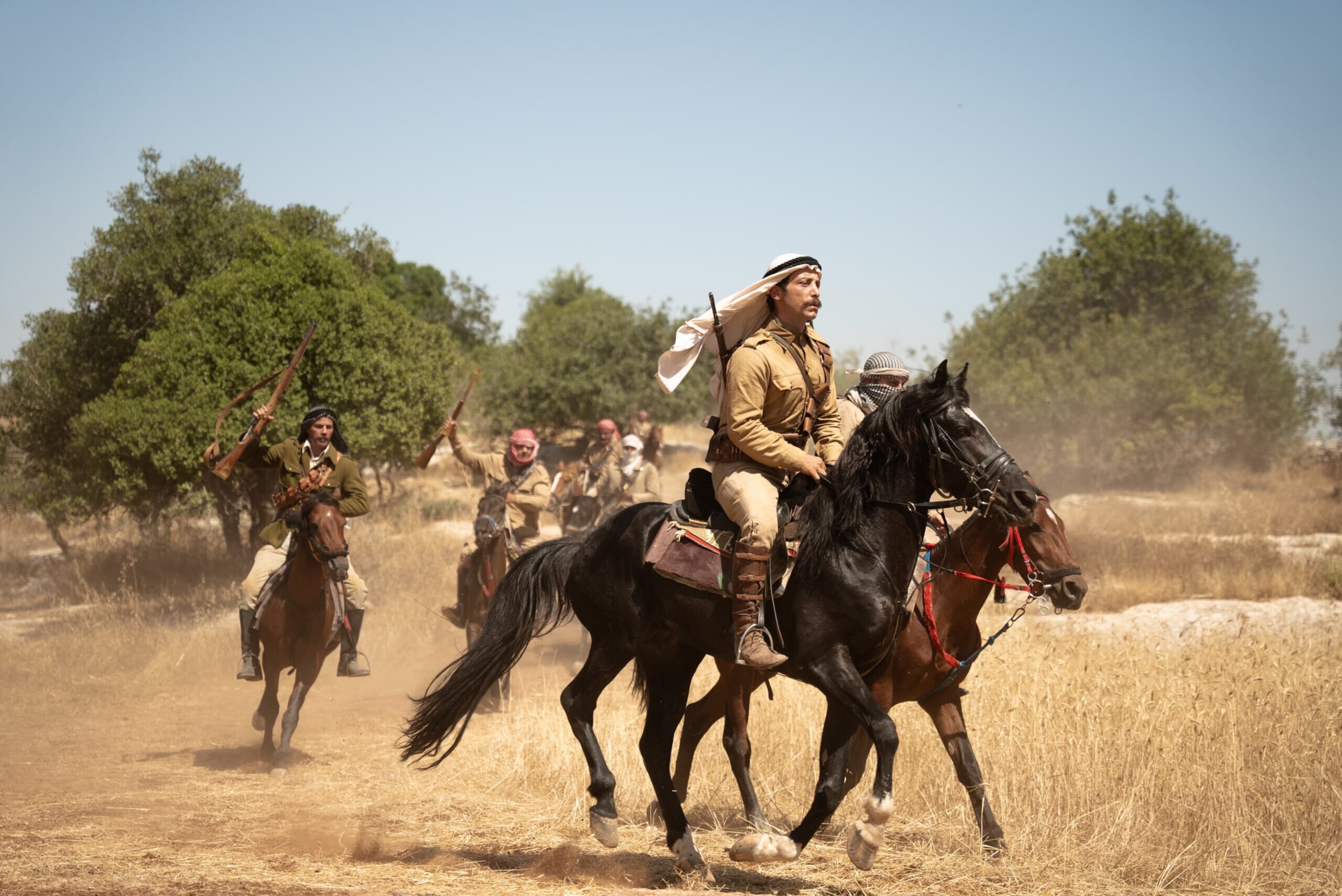
Skillfully, Jacir brings the viewers back to the ‘30s. It’s the seamless mixture (editor Tania Reddin) of old and new footage. The blending of faded and vivid colors across eye-catching scenes—cotton fields, resistance fighters on horseback, military caravans and palatial mansions. Production designer Nael Kanj reimagines the homes, both simple and ornate. Clothes (costume designer Hamada Atallah) aptly distinguish villagers, aristocracy and soldiers and reinforce their identities. Cinematographers Hélène Louvart, Sarah Blum and Tim Fleming capture the film’s intimacy and brutality with equal verve. Ben Frost composes heart-wrenching music with restrained low-tone viola and cello instruments that accentuate in the most foreshadowing ways. Nothing about the footage feels modern. More like Beau Geste (1939), though opposite in themes.
Parallels to today’s issues and similar interpretations of social/political oppression mark this film’s high standards: Arabs have to carry ID papers in their own homeland and are being interrogated by soldiers, which echoes current U.S. immigration security methods. Rich Palestinians cozying up to the enemy and thinking they’re immune, mimics films like Victor de Sica’s 1970 classic The Garden of the Finzi-Continis, where social privilege was not a bulwark. Watching Jewish settlers encroach on Arab lands was also exposed in the Oscar-winning Documentary Feature No Other Land.
This sweeping epic is filled with enough material for a Netflix mini-series. Yet the storytelling has been judiciously and artfully condensed. Jacir, an astute filmmaker, knows the assignment: Recollect the history, chronicle the peril of Arab communities being displaced. Depict the migration of Jewish people in need of a homeland. Explore the causes and consequences of the times. Her interpretation of events, mixed in with fictionalized characters and command of her craft is high caliber filmmaking. Close to that of Bernardo Bertolucci’s The Conformist or Roman Polanski’s The Pianist.
What Jacir teaches viewers about the evils of tyranny and brave resistance channels from the ‘30s through to today. Palestine ’36 is an allegory of epic proportions that resonates.
Photos by:
Trailer: https://www.youtube.com/watch?v=2bk9dPHEfWU
Visit Film Critic Dwight Brown at DwightBrownInk.com.