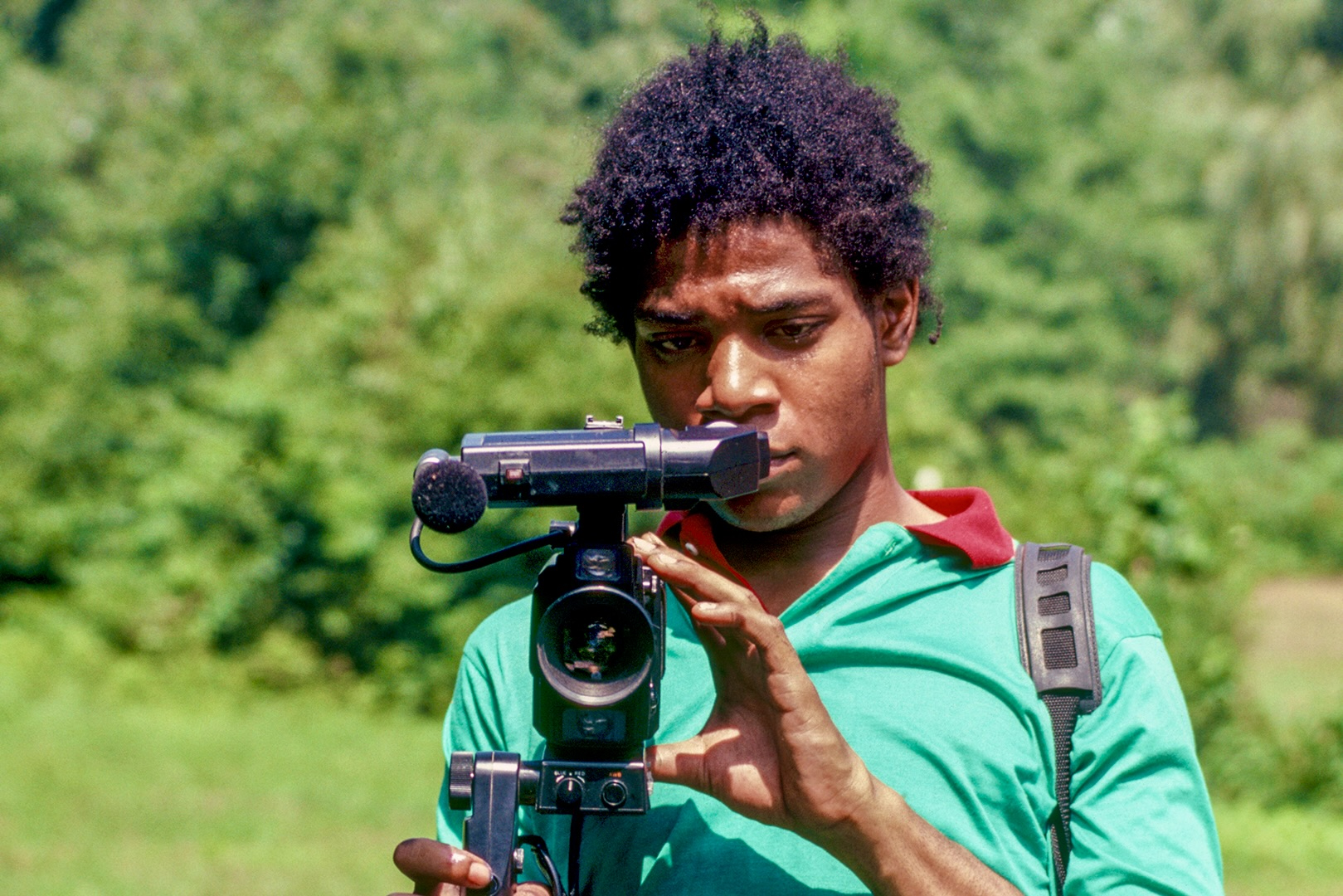
(***1/2)
“I’m happy I can do what I like to do and survive on that.” Getting to that point wasn’t easy. Getting past it was a blast.
Viewers who venture out to see this documentary get a full picture of the artist and how he became a cultural phenomenon. Starting life as a Brooklyn-raised child of middle-class immigrant parents gave him a base. Being critically injured in a car accident at age seven caused a major detour. Dropping out of school put him on a different path than his siblings. Rummaging for coins on the floor of the gritty, counter-culture Mud Club Bar in the ‘80s showed how desperate things got in his adolescent years. And at long last making ends meet was a dream fulfilled. But there was more to come for Jean-Michel Basquiat.
Those are the details in this illuminating documentary. A bio/doc that’s executive produced with certain pride by Basquiat’s two sisters, Jeanine Heriveaux and Lisane Basquiat. They’re out to set the record straight. Their brother has been painted as an enigma or a homeless person with no roots. Few know the backstory of this Haitian/Puerto Rican young man. An icon who led the 1980s Neo-expressionist movement. Now he’s getting his due. He’s being celebrated for his raw, poetic street art and his masterpieces that have amassed over $7.2 billion in cumulative sales.
Directors Quinn Whitney Wilson (former creative director for Lizzo and a pro in the field of queerness and blackness in modern media) and Viridiana Lieberman (editor of Emmy®-award winning films, Lowndes County and the Road to Black Power) lead this exploration in thoughtful, thorough and reflective ways. Their visual style mimics expressionistic art. Yes, there is a substantial amount of interviews, testimonials, home videos, photos and clips. But at certain intervals the montage is quixotic. More an impression than hard reality. Staccato. Bits of images. Glimpses.
Visions of New York and its downtown hip culture scenes flourish. Splashes of art that look as fresh and improvised as Basquiat’s paintings abound. The quirky musical score (James William Blades), judicious editing (Rebecca Adorno and Lieberman) and prying cinematography (Jo Jo Lam) work like a suite of art tools to deliver a doc in the mode of its subject. In so many ways, Basquiat’s spirit is captured and on view and the tech crew is an integral part of that magic trick.
Recollections from the sisters, friends, relatives, fellow artists and those in his orbit then and now add important details to this picture. Jeffrey Wright, who starred in the biofilm Basquiat (1996), explains his aura. Wright recalls: “He vibrated on a different wavelength. He was a disrupter.” Artists who came after him revere his pioneering ways: “Jean-Michel went through things, so others (black artists) didn’t have to.” Fellow artists like Keith Haring and Andy Warhol are put into perspective. As is his love life (Madonna, Jennifer Goode) and his fated drug addiction. There’s enough stuff here to fill a Netflix series. Yet somehow all the revelations about Basquiat fit into this engaging 95-minute format.
There are two real stars in this touching non-fiction film. Basquiat himself, who through footage of the artist as the first child in his family, his tumultuous high school years and professional life, feels as though he’s come back from the dead. A depiction that is far more graphic, vivid and haunting than any of the documentaries or biofilms that have been previously produced about him. This feels like the most definitive accounting.
The second biggest star in this doc is his artwork. The quantity and quality of his graffiti, paintings, performance art and other work form a strong record of his legacy. It’s as if his artwork is screaming: “Look at me. I am his life! His vulnerabilities, playfulness, seriousness and indelible self-image.” Certainly, what he tried to accomplish is evidenced by what he left behind and the admirers he continues to amass every day. And that’s evident in nearly every frame.
Basquiat’s sisters have had their say. They and the film’s team have pulled together what feels like the ultimate expression of their brother’s life art, mission and humanity. He died at age 27 in 1988. And thirty-eight years later, his popularity is stronger than ever. His painting Untitled (1982) sold for $110,500,000 in 2017. His work is still valued. Still admired. This doc puts Basquiat’s fame, talent and soul into perspective.
It’s a gem. An exhibition. Immersive. Like following Basquiat around NYC from the hard times, when he scrawled cryptic images on walls, to his bountiful years, when splashy gallery showings became the norm.
For more information about the Tribeca Film Festival go to: https://tribecafilm.com
Visit Film Critic Dwight Brown at DwightBrownInk.com.