(***1/2)
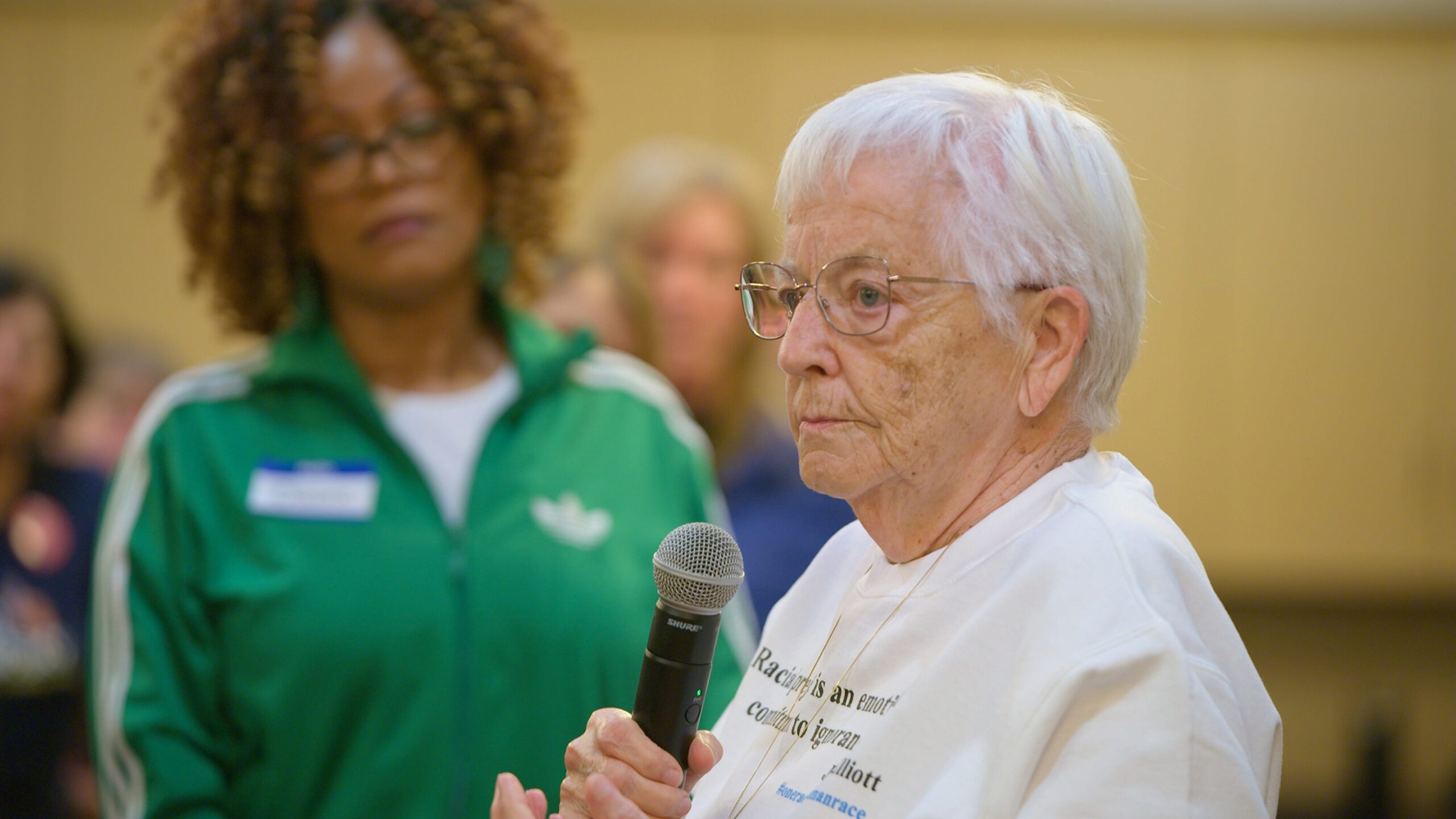
Sometimes you have to clean your own house first. That’s what anti-racism activist and diversity educator Jane Elliott has been doing for decades. At age 92, she ain’t stopping. This probing doc is telling audiences why.
Elliott has reasons, lessons and successes in changing stubborn bigoted mindsets. Guidance that should be captured, repurposed and taught for decades to come. Thankfully, documentarian Judd Ehrlich (The Price of Freedom) sees the necessity and urgency and focuses on truth-telling by observation and display and not confrontation. He’s more an archivist than an interventionalist, a passive documentarian who lets the people, facts and life story do the heavy lifting. Hence this extremely educational film teaches a lesson that may be even more important today than it was in the late ‘60s. With Jane as the sun and family, friends and former students as the stars around her, this doc tells the story of a small but hugely brave schoolteacher who discerned a moral urgency in 1968
After the assassination of Martin Luther King, how do you channel shock and grief into a teachable moment for a third-grade class in nearly all-white Northeast Iowa? Elliott found a way. She created, and still conducts, a blue eyes/brown eyes exercise. Divide the room into these two categories. Let one side abuse or deprive the other. When that’s over, give the other side the opportunity to do the same to the other group, if they will. And some wouldn’t. The instant result was empathy, a distaste for injustice based on experience and a moral to the story that changed her students’ attitudes about bigotry for a lifetime.
Simple, easy, educational and appreciated tool? Not hardly. That landmark day in education came with a price. Elliott and her family were harassed for teaching fairness, equality and mutual respect among races. Yet the exercise was repeated in classrooms around the country, regardless. It led Jane to appearances on The Oprah Winfrey Show, The Tonight Show Starring Johnny Carson and other showcases. But wherever she sought to level the playing field, anger from racists followed her. These days, her thoughts are more controversial than ever. Her views are demeaned by the federal government, the Education Department—or what’s left of it. She’s banned from some schools, as if wanting equality for all was a disease.
The timing for this very inquisitive and enlightening doc couldn’t be better or more needed. Elliott, emphatically and almost saintly, still communicates the importance of teaching fairness in schools: “Educators lead people out of ignorance. Teachers teach stuff so kids pass a grade.” That said, the camera doesn’t shy away from the less socially conscious parts of Elliott’s life. She’s the daughter of a racist dad and was once reluctant to sell her house in an all-white neighborhood to a Black person back in the day. It’s a background and set of mistakes she owns. “Wish I hadn’t never done that” moments that changed her forever. Hearing her past, knowing her imperfections and seeing her change—for the better—is compelling cinema.
Outlining the previous events is interesting but when the film switches to present-day challenges it becomes even more engaging. A sequence that depicts Elliott helping teachers and students recall a school board director who is a white Christian nationalist and racist shows her and like-minded people in action. Modern-day Temecula, California is on view. Books by Black authors are being taken out of libraries. Black activist teacher Dianne Solomon Cox, Black students and Elliott are on the frontlines. She’s still giving fiery speeches: “There is no gene for racism, sexism or antisemitism. I will never get along to go along with racism!” This section of the film is like a call to action. It’s invigorating.
For 99 minutes, a genius anti-racism educational theory is applied in ways that are quite immersive. Clips, old footage, TV shows and press conferences are aptly assembled. Cinematographers Peter Eliot Buntaine and Sean Hanley catch the action like it’s an episode of TV’s 60 Minutes. All those willing to comment on race relations, do. From equality advocates like Ibram X Kendi and Killer Mike to those who question the merits, like Donald Trump and Kash Patel. The subject matter is debated and expanded on well.
Some of the doc’s length could use a clipping (editors Max Powers, Leah Goudsmit and Albin R. Pepe). Once Elliott’s past is established, present day and future thoughts seem more important for maintaining an audience’s attention. Onlookers may wonder, “How does this affect me today?” It’s an area that deserved more time, not less. Also, the comments her adult children make about how they took a back seat to their mother’s crusade provide a balance to the effusive look at Elliott’s accomplishments. Pride, anger, dereliction and hope are duly noted. While feelings of inspiration are likely what viewers will embody.
Educators should know the merits of Elliott’s teachings. That’s the gift documentarian Judd Ehrlich gives. The life lessons Jane Elliott champions are being passed on to the next generation. “Jane Elliott Against the World.” No. “Jane Elliott Saves the World.” Yes!
Photos courtesy of the Sundance Film Institute by Peter Eliot Buntaine
For more information about the Sundance Film Festival go to: https://festival.sundance.org
Visit Film Critic Dwight Brown at DwightBrownInk.com.