(**½)
Like Robin Hood and his band of Merry Men, these thieves steal from the rich to give to the poor.
But for how long? That depends on screenwriter Mark Bianculli’s crime-thriller script and whether the storyline can sustain its carefree robbery approach without tiring its target Gen Z audience. Frustrated teens and those grievance-heavy twentysomethings who feel locked out of the American Dream might take a break from social media binging long enough to go on this crime spree. They may stick with this eclectic band of thieves, led by a bleached blonde, bad-attitude prince who’s got an ax to grind against banks and how they treat the less fortunate. Or they may just do a drive by and move on.
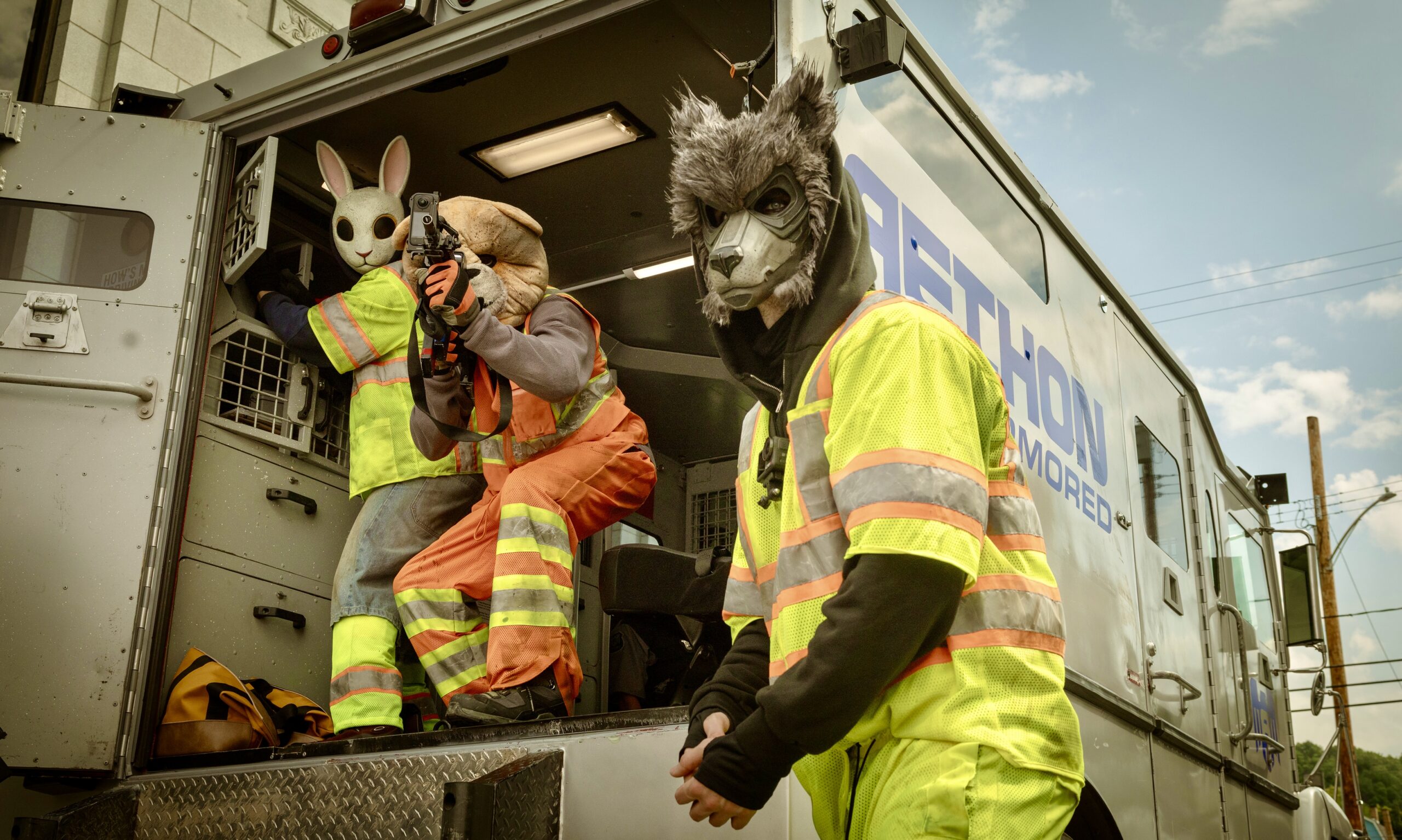
The very contemporary premise gets a big boost from wacky pop-up graphics, overlays, digital avatars and QR codes. The kind that hypnotize viewers on TikTok and YouTube, sending them down rabbit holes where algorithms keep them entrapped. Costume designer Jocelyn Pierce starts the cast of robbers off in odd clothes from construction worker garb to security guard uniforms and animal outfits. Art director Marika Stephens and supervising art director Jeremy Woolsey pick bright, animated colors as images of the real-life characters metamorphose into cartoonish figures.
Production designer David Scheunemann pulls viewers into this altered universe, whether the characters are in loft spaces, tenement apartments or big banks. Makeup artists apply exaggerated shadows around eyes and top off looks with quirky platinum-blonde wigs. In a crucial bridge scene, the oversaturated hues of yellow and blue heighten the pop-art sensibility captured by cinematographer Jonathan Sela (Bullet Train). It’s a good thing that the visuals are alluring and that composer Dominic Lewis (The Fall Guy) provides a soundtrack with verve. All that almost makes up for the times when the film loses momentum.
The Wolf, aka Ryan (Nicholas Hoult, The Great and The Favourite), has a deep-seated grudge. That’s what drives him to lead a group of misfits as they rob banks and share their exploits live on social media video rants. Not just to show off, but to show others how it’s done. He wants his followers to walk in his footsteps. He isn’t alone. His girlfriend Emi (Anna Sawai, Shōgun) supports his criminal endeavors and is becoming a top-notch getaway driver who can spin a car with the best of them. Vince (Pete Davidson), a military vet with health issues who struggles to support his family, teaches her the finer points of speeding off and evading after a bank robbery. The tight-knit crew is augmented by Hugo (Rhenzy Feliz, The Penguin), a Latino tech whiz and supreme hacker who captures Ryan’s rages against the machine and broadcasts them to the world.
Bank heist movies are as common as rain. Setting a crime film apart from the legions of others in the genre isn’t easy. Tarantino did it with Reservoir Dogs, using extreme graphic violence and an unconventional narrative structure. Set It Off featured an all-Black female cast. Dog Day Afternoon combined a bank robbery intended to finance the robber’s partner’s gender-affirming surgery with Al Pacino’s bravura performance. Director David Leitch (Bullet Train, The Fall Guy) and the film’s producers try to distinguish their project through pop-culture visuals and the desire for revenge among those hurt by insensitive banks. Their approach has more potential than the film ultimately realizes. There’s a social commentary about rebelling against today’s injustices, but it’s thin. Even thinner than the commentary in One Battle After Another.
Leitch is a pro at creating and shooting over-the-top action scenes. Anyone who witnessed Bad Bunny, Brian Tyree Henry and Brad Pitt aboard that speeding locomotive in Bullet Train, with its elaborate, eye-catching action sequences, may wonder why Leitch didn’t unleash that kind of spectacle here. There are plenty of opportunities for outrageously choreographed heists and escapes, but those that make it onscreen are neither spectacular or indelible. The pop visuals are striking in a smirky way, but still not enough to redefine the genre.
The young crooks don’t go unnoticed. Stuck-in-the-past FBI Agent West (John C. Reilly) is on the case. Which is something like assigning Sherlock Holmes to investigate a cryptocurrency crime spree. For this older gent, analog is his game; digital is not. He needs someone to bring him into the 21st century world of gadgets and tech, which is why he tracks down Reagan (Zoë Kravitz, Blink Twice). She’s a professional software developer with expertise in digital tracking—and she’s easy to find. Why? She’s on lockdown. The two meet, and like Holmes and Watson, they follow the clues in hopes of tracking down the crooks.
Much of what unfolds consists of short, fast-paced scenes, adroitly assembled by editor ElísabetRonaldsdóttir. However, the loss of momentum becomes noticeable during conversations between West and Reagan. These are moments when audience attention may waver, although the performances occasionally perk up the lackluster exchanges. Reilly’s version of the doddering sleuth gives his character a fish-out-of-water awkwardness that’s fun. Kravitz is cooler than ice as Reagan, the sardonic tech genius. She has an odd secondary characteristic: she’s endlessly munching on snack foods. As she noshes her way through the movie, it’s almost like watching a French actress smoke cigarettes incessantly as a character trait or acting crutch.
Feliz’s take on Hugo is very blasé and informed. Easy to like him, his family and neighbors. Davidson’s interpretation of Vince may be his most accomplished performance yet. He’s sarcastic at times, but never outlandish. Instead, he seems to be hiding emotions beneath a veneer of humor. His line delivery is fluid, his emotions run deep and it’s easy to believe in and care about his predicament. Sawai’s delight as Emi learns to perform spins in what look like a 1970s Oldsmobile is charming.
The weight of the movie rests on Hoult’s shoulders. He must convince audiences that Ryan is so deeply wounded he’s compelled to retaliate against the institutions who have robbed him of something important. His despair is so profound that it carries him from heist to heist, searching for the chance to stick it to the man: “When justice isn’t given, we take it!” For the most part, his blend of boldness and vulnerability is effective and convincing—a feat the film as a whole cannot claim.
The pop-culture sensibility and real-time social media commentary make this crime story different, but never extraordinary. That could hurt its box-office prospects during a theatrical run. On the other hand, once the film lands on Amazon Prime and viewers plop themselves on their couches with a bag of chips in one hand and a joint or beer in the other, this little story about those who steal from the rich to give to the poor may find its real home. Bank on it.
Trailer: https://www.youtube.com/watch?v=ORxw68y3lyw
Visit Film Critic Dwight Brown at DwightBrownInk.com.