(****)
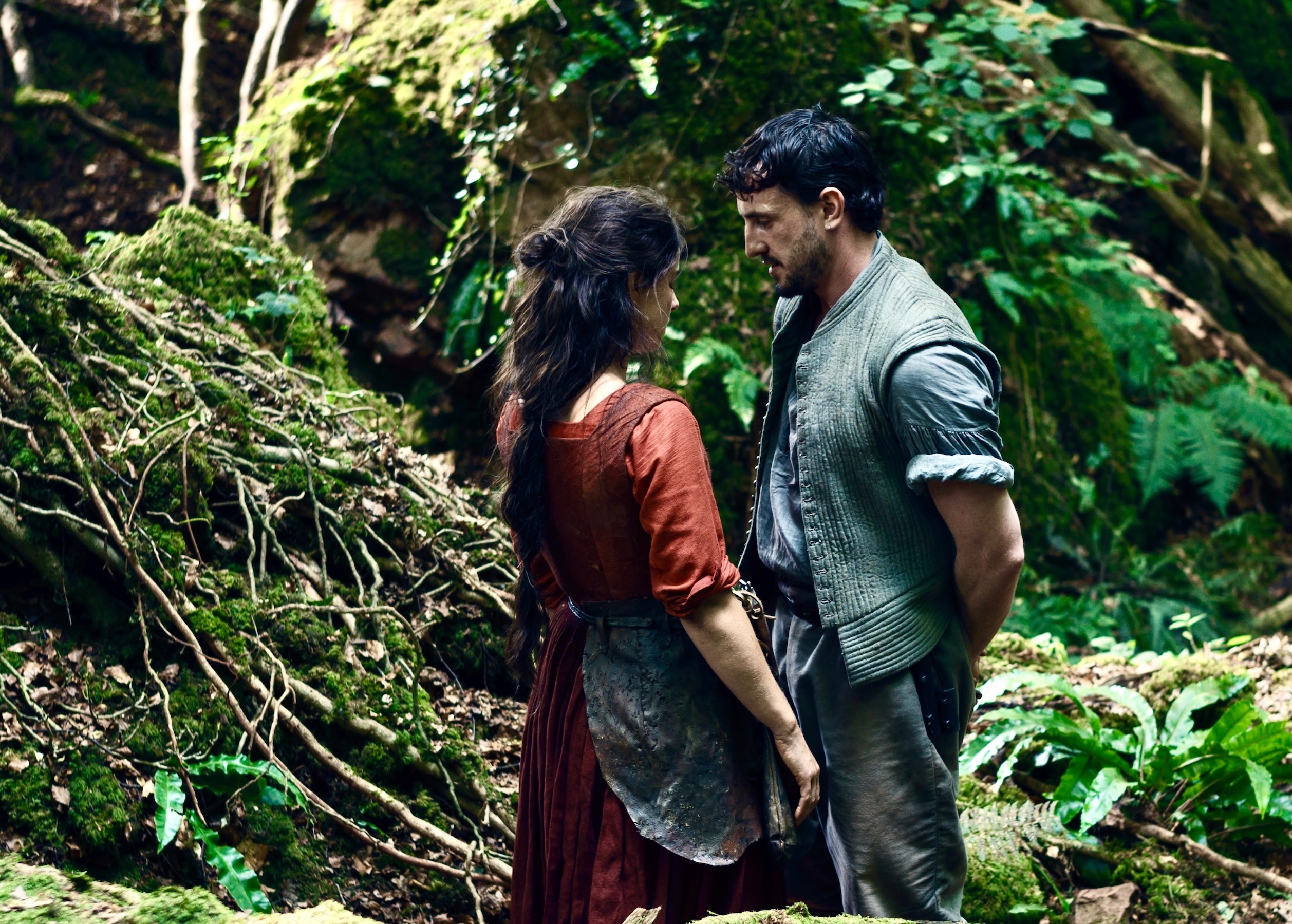
She and the forest are one. Some might call her a witch. But they’d be wrong. She’s more like a daughter of mother nature. Destined for love and tragedy of Shakesperean proportions. Something she could foretell: “The women in my family see things.”
Sometimes she lays curled up at the base of a tree. Falcons land on her arm. She forages in the woods for medicinal herbs. It’s as if the earth speaks to her, or at least is her spiritual guide. Agnes (Jessie Buckley) lives her own life. Some would say she’s peculiar. Different from that of the other villagers in Stratford-upon-Avon, England in the late 1500s. Narrow-minded folks who chide her for being feral. For listening to gut feelings. That individuality attracts the young Latin teacher Will (Paul Mescal) who’s beguiled by her rebellious, mystical nature. He’s just returned from London, is living with his parents and trying to figure out his life.
That’s the set up and premise of the 2020 novel Hamnet by Maggie O’Farrell. In 2023, that book was adapted for stage by Lolita Chakrabarti and opened appropriately at the Royal Shakespeare Company in Stratford-upon-Avon. Following that lead, this film version is headed by the Oscar®-winning director Chloé Zhao whose 2021 effort Nomadland won the Academy Award for Best Motion Picture of the Year. Proving that recognition was well deserved, Zhao has masterfully and artistically turned this romantic period drama into an epic worthy of another Oscar® nod or win.
The director/writer crafted the evocative script with co-screenwriter O’Farrell, the book’s author. Some filmmakers create their cinema like a journeyman, architect or in a formulaic way. Clearly Zhao is more like a painter. Choosing her colors and settings carefully (production designer Fiona Crombie, art director Victoria Allwood, set decorator Alice Felton). Lighting interiors and exteriors in ways that evoke the times almost like a storybook. Composing shots deep in the woods, on London streets and in homes during perilous births with the utmost care (cinematographer Lukasz Zal, Cold War, Ida). Then adding a musical score (Max Richter, Arrival) that makes scenes in the forest melodramatic, romantic dalliances sweet and tragedy devastating beyond words. Somehow slimming the footage down to 2h 5m of tight scenes that build to a wondrous climax (editors Affonso Gonçalves and Zhao). These are the paints, textures and brushes. Her tools.
Zhao is also a supreme storyteller as she unravels a love tale involving misunderstood souls living in unconventional ways, pulled together by fate and alienated by abject loss. Courting. Marriage. Children. That’s as traditional as the couple gets. First bringing a daughter, Susanna (Bodhi Rae Breathnach), into the world, who’s birthed in the woods. Next twins Judith (Olivia Lynes) and Hamnet (Jacobi Jupe). Agnes is secure enough to let her husband chase his writing, a career and dreams. Then fate takes away someone they love dearly. An act that puts a strain and wider wedge in their relationship. Can they find their way back to the love they had?
Romeo and Juliet have nothing on Agnes and Will. Their devotion is that deep. Others want to tear them apart, too. The hardship that effects their lives is almost as tragic. Zhao spins this achingly profound fable in the most magical ways. With gladness balanced by sorrow. Hope balanced by failure. A delicate mix of history and fiction that puts the world’s most famous playwright’s life into perspective. The narrative is increasingly fascinating. The time and place meticulously set. The dialogue expressive. Character arcs evident. Emotions heartfelt. The gifted director sees to that. She’s helped greatly by the cast assembled to play 16th century characters who’ve lost their way.
Buckley’s ethereal interpretation of Agnes is a unique blend of spirituality, determination and bitterness. The deep-seated emotions she displays range from romance to motherly love, to the grief and anger that festers when death comes to her house. Mescal plays the aspiring academic and writer like he’s so motivated by creating and perfection he’s incapable of arresting his innate ambition—even for his family. Then grieves his choices and finds ways to manifest that sadness.
The brilliant young actor Jacobi Jupe, as the couple’s son, has some of the film’s most dramatic and pivotal scenes. Particularly one in which he tries to protect his twin sister Judith, who is gravely ill. He can sense that death is in the room. Almost see it. It’s a tender, sweet and foreboding moment. The fiery portrayal by David Wilmot as John, Will’s stubborn, exacting and abusive father, is diametrically opposed to that performance. Emily Watson as Mary, Will’s more flexible mom, is initially apprehensive about this choice for a wife: “I’d rather you go to sea than marry that witch.” Watson makes her character’s journey earnest and believable.
The less adult audiences know about the background of this movie, the more astounding the experience will be as the mind-boggling revelations add up. They’re well measured out towards the end of the story in the most ingenious ways. Credit O’Farrell and her book for planting the seed. Then Zhao, her production crew and cast for developing it into a captivating saga.
The woman from the forest has a lot to learn about life and forgiveness. Watching her metamorphosis is transfixing. And seeing how it segues into one of the most famous plays ever written is an ever-evolving source of enchantment. A magic of Shakespearian proportions. Something that will leave audiences spent and in a meditative state. “To die, to sleep, perchance to dream.”
Trailer: https://www.youtube.com/watch?v=xYcgQMxQwmk
Photos courtesy of the Toronto International Film Festival. Photo by: Agata Grzybowska
For more information about the Toronto International Film Festival go to https://tiff.net/.
Visit Film Critic Dwight Brown at DwightBrownInk.com.