(***)
You know you’re brave? You know you’re brave when you go into Gaza in 2025, in the middle of a war with mass casualties, and try to save lives.
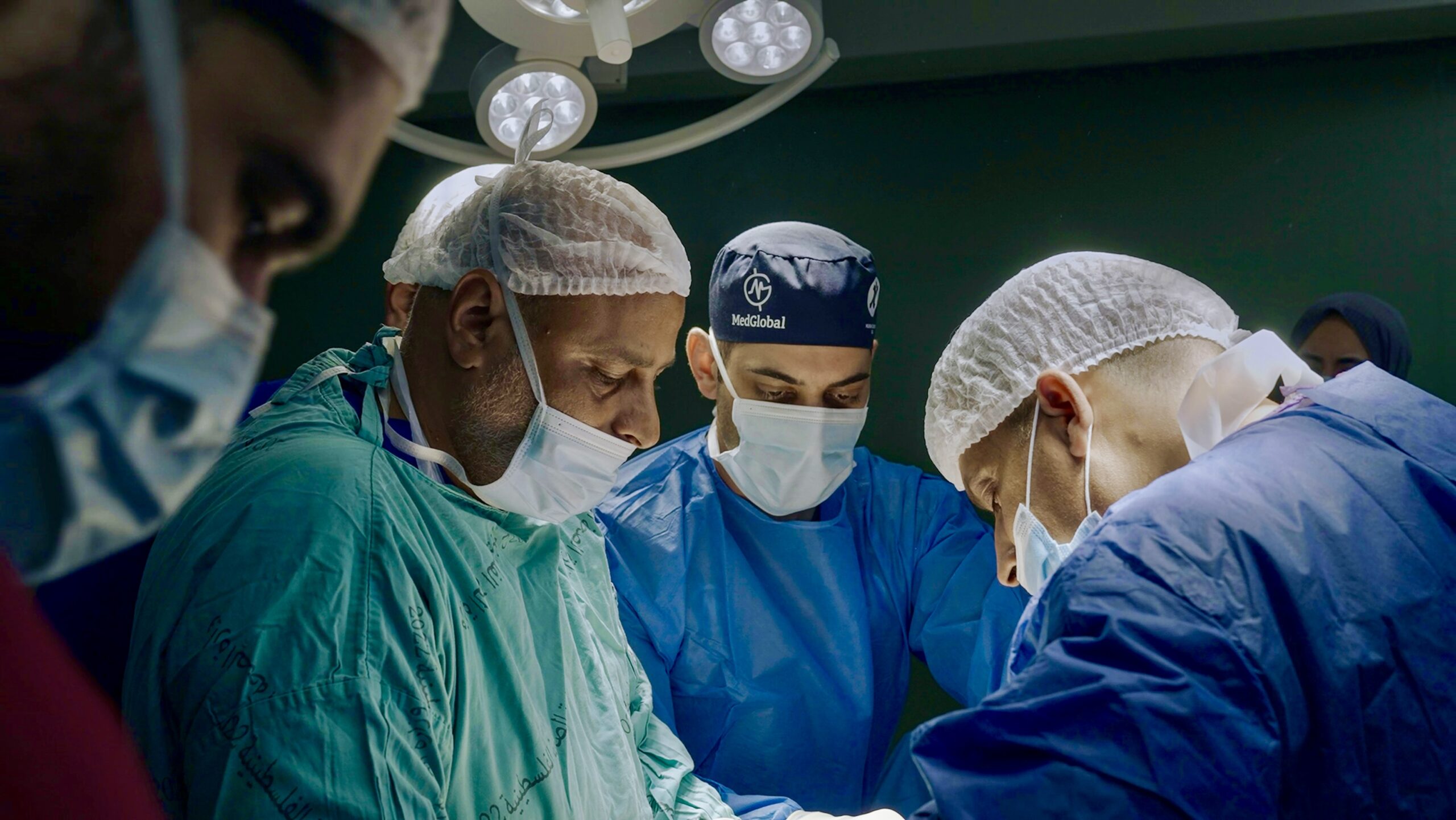
That was the calling of three American doctors of different ethnic backgrounds who were willing to risk their safety to bring care to those in need: Thaer Ahmad is an emergency medicine physician of Palestinian descent based in Chicago. Mark Perlmutter is an orthopedic surgeon from North Carolina, a Jewish-American. And Dr. Feroze Sidhwa is an American trauma and critical care surgeon based in Stockton, California whose family is from Pakistan. They’re doctors by profession, humanitarians by calling. All spend quality time at the Nasser Hospital in Khan Younis, the largest healthcare center on the southern Gaza Strip.
Director Poh Si Teng and a courageous camera crew (Ibrahim Al-Otla, Chris Renteria, Arthur Nazaryan and Ramzy Haddad) record their mission abroad and their speeches, conversations and pleas in The States. The team’s use of natural lighting, perfect framing and smart composition almost seems intuitive. As a team they capture candid and profound thoughts. Personal viewpoints: “I’m a doctor who doesn’t want to see babies who look like my baby killed anymore.” Survivor’s guilt: “When you leave Gaza you feel like you have no right to leave. You feel shame.” Outrage from Mark, who says his father provided aid in death camps during WWII, may be the most exacting: “…Stop grabbing land from people who’ve lived there for a millennium… Evil of Zionism…Cruelty.”
Wherever they go, whatever they see is captured on film—from the corridors of Nasser Hospital, one of the last functioning medical centers in Gaza, to operating and triage rooms filled with the wounded. The images are harrowing: maimed children, rows of bodies, the relentless aftermath of bombardment. Viewers are confronted with the same chaos the doctors endured—bombs exploding nearby as they worked amid the rubble of collapsed homes, apartment buildings and stores. Yet even that proximity to danger cannot equal the suffering experienced daily by Gazans themselves. The doctors carry those memories with them: the lives they saved, the ones they couldn’t, the patients they left behind and those who didn’t survive.
Editors Christopher White and Ema Ryan Yamazaki trim the footage down to a succinct 91 minutes. Composer Suad Bushnaq creates the right kind of score for a documentary that’s so filled with agony, rage, love and bravery. The subject of the Israeli-Hamas war, its beginning, middle, end and aftermath, is a debate that will rage for decades. Films like this give the conflict personal perspectives—outsiders’ observations. These are people who can compare what they see here to what they’ve experienced at Ground Zero, in Haiti or Ukraine. It amplifies the tragedy and callousness in ways that could be more tangible to theater, streaming and academic audiences.
Three scenes/sequences have a particularly distinct impact, which is saying a lot as there are so many devastating moments: 1. A Palestinian hospital worker is torn between saving lives and taking care of his family—both dire needs that many fathers relate to. 2. Showing bodies of men, women and children that’ve become a mosaic of death after a bombing. 3. The transition from war-torn Middle East to the United States, where too few seem to understand the magnitude of the situation. It’s a stark duality.
Teng’s style is unfettered cinéma vérité, no frills and just hard reality. Especially when the doctors are deciding who they can save, mend and return to their families—if there’s any kin left. No editorializing, just straightforward chronicling. This is film as a witness and necessary documentation that’s sobering, graphic but never exploitative.
It’s easy to be overwhelmed by the enormity and consequences of action and inaction. None of it is sensationalized by the direction, crew or participants. No section of Gaza, house of worship or hospital is safe. Nothing. It’s graphic and scary, but not as emotionally devastating as other horrific war documentaries (e.g., Last Men in Aleppo).
Relaying that the situation is dire in Gaza becomes the mission of three American doctors, a film crew and the Gazans who speak out. All on view are brave beyond words.
Photos courtesy of the Sundance Film Institute and by Ibrahim Al Otla
For more information about the Sundance Film Festival go to: https://festival.sundance.org
Visit Film Critic Dwight Brown at DwightBrownInk.com.